The IEC 60601-1 4th edition, in one place: the map, the timeline, and where to actually start

The IEC 60601-1 4th edition, in one place: the map, the timeline, and where to actually start

Almost nobody reads a thousand-page draft cover to cover. So here is one place to get oriented, then go deep only where it touches your device.

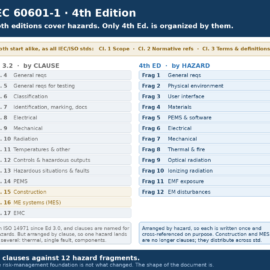
You have heard the headline: the IEC 60601-1 4th edition is coming, and it is big. Edition 3.2 is around 500 pages. The 4th edition is heading past 1,000, written across twelve hazard-based working groups.

The headline is not the useful part. The useful part is the question underneath it: where do you start, and what do you actually need to read? Almost nobody reads a thousand-page draft cover to cover, and nobody should have to. So this is a hub. It is one place to get oriented and then go deep only where it touches your device, as your device likely will not touch every corner of the standard.

EN 60601-1 Harmonised, and “EC REP” Becomes “EU REP”: Annex ZZ, State of the Art, and the MDR Questions the Headlines Skipped

EN 60601-1 Harmonised, and “EC REP” Becomes “EU REP”: Annex ZZ, State of the Art, and the MDR Questions the Headlines Skipped

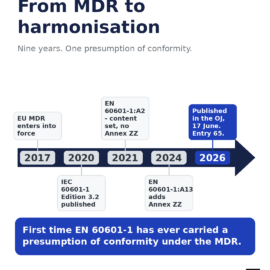
After the Official Journal harmonised EN 60601-1 on 17 June 2026, I later wrote up an overview: what changed, the nine-year wait, what to cite, and the EC REP to EU REP switch riding alongside it. Then the comments started, and the good ones went straight past the headline. This is the deeper cut.
This post assumes you already know that EN 60601-1:2006/A13:2024 landed at entry No. 65 and that A13 carries Annex ZZ. From here I want to answer the questions my readers actually asked. I have deliberately not repeated much of what is already in the LinkedIn article, which covers the background, the full decision, and several points I do not revisit here, so it is worth reading alongside this.

Keep the Patient at the Center: My Full Week at IMSC26 (and Why Getting Ahead of IEC 60601-1, 4th Edition Is Really About People)

Keep the Patient at the Center: My Full Week at IMSC26 (and Why Getting Ahead of IEC 60601-1, 4th Edition Is Really About People)

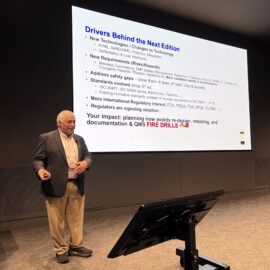
Two events across Greater Boston, and the most energizing week I have had in MedTech in a long time. It started in Boxborough with the TÜV Rheinland North America IEC 60601-1, 4th edition seminar, then rolled into four days at IMSC26 in Boston: a 4-hour CEF/CEP workshop, a 45-minute session to a packed room plus a virtual audience, and a stack of hallway conversations I am still thinking about.
What I did not expect was how often the human side moved to the front. A patient’s own account of life on the receiving end of a device. A regulator speaking candidly about where the FDA is headed. Combination products, risk management maturity, usability, and the quiet, unglamorous work of writing the standards themselves. Different rooms, different speakers, the same gravitational pull back to the patient.
So I wrote up the moments that earned a place in my electronic notebook, what they mean for teams designing and testing products right now, and where IEC 60601-1, 4th edition fits into the picture. Less a conference summary, more a field report from someone who has spent 30-plus years in this work and still came home with a full page of new ideas.

IEC 60601, 4th Edition: What’s Changing and How to Prepare

IEC 60601, 4th Edition: What’s Changing and How to Prepare

IEC 60601-1, 4th Edition
Strategic Shifts and How to Prepare

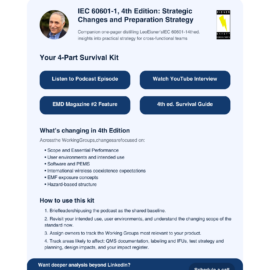
Companion post to my Easy Medical Device podcast episode on IEC 60601-1, 4th Ed., focused on what is shifting across the Working Groups and what RA/QA, Design, Test, and Management teams should do now.

Most organizations will feel the impact long before any formal transition date. The practical shift is that evidence expectations are tightening, scope is becoming clearer, and the standard’s direction is being shaped now through Working Group outputs. Teams that treat this as a design input and planning topic today will avoid late-cycle surprises in test strategy, labeling, and documentation tomorrow.

Dec 22, 2025: FDA Updated Its Recognized Consensus Standards db 100+ New Or Updated Standards

Dec 22, 2025: FDA Updated Its Recognized Consensus Standards db 100+ New Or Updated Standards

Key themes: IEC 60601/80601, IEC 61326-2-6, ISO 15223-1 A1:25, & ASCA considerations

In late December 2025, the FDA expanded its Recognized Consensus Standards Database, adding more than 100 new or updated standards. Some are eligible for use under the ASCA Program, while others carry important implications for design, testing, labeling, and overall regulatory strategy.

Regulatory expectations around standards are shifting earlier in the product lifecycle. Standards are no longer something teams can simply “handle at test.” Reviewers increasingly expect standards interpretation, risk decisions, and test strategies to be visible and justified during design reviews and technical documentation development. This reinforces why understanding not just which standards are recognized, but how they are recognized and applied, matters more than ever.